
Education is rather different today, than it once was. Of course, there should be room for change over time. However, in changing, we have lost a great deal. We have lost educational content, historically accurate data, ethical focus, purpose, honor and we have created many learning difficulties, if not true learning disabilities, like dyslexia. (11) Schools no longer teach a great deal of things. Why teach latin, when we can teach modern dance? Latin is a dead language after all, and students enjoy being modern. Or so they say. Besides, self-expression is “so important”.
If we are to understand where we are we need to know what we have lost. We need to compare the past with the present. One simple, very good example is teaching a child to read. It is often described in the same tones as a root canal. Yet, it is something that most teachers and parents have at least attempted.
Lesson 1 in Webster’s Speller (for ages 8 and under) teaches the multiple phonic sounds used by the letters a, e, i, o and u with the following text:
“No man may put off the law of God.
My joy is in his law all the day.
O may I not go in the way of sin.
Let me not go in the way of ill men.” (1)
Lesson 1 in Hooked On Phonics (for ages 8 and under) teaches the use of the letter a with the following text:
“Dan.
Bat.
Dan at bat.
Dan ran.
Pat.
Pat at bat.
Pat ran.
Dan ran.
Pat! Dan!”
Obviously, the Webster’s text violates our current cultural obsession with removing Christian content from public (tax-payer funded) education. (This is not law, but originates from an 1802 letter from President Thomas Jefferson to a church group.) However, the larger and more important point is that we have gone from teaching all five vowels, their multiple uses and … well I really don’t know how many other sounds as I haven’t taken the time to count them, to teaching one use (sound) of one vowel and six letter sounds, d, n, r, p, b, and t. Perhaps teaching reading is such a chore because it’s become a bore? Regardless, the manner in which reading is taught has changed and the results have changed. Most importantly, the quality of instruction over 200 years has degraded so much as to have nearly dropped off a cliff. This is just one example. Truly, there are many, many more.
We have lowered our standards at the same time that we have technically expanded educational content. Today each state has legal standards on every educational topic from abstract art to zoology. Few of Pennsylvania’s elementary school students go on from the lessons in cosmetology to a career in cosmetology. (12) However, all of Pennsylvania’s elementary school students need a solid foundation in “The Three R’s”. We are failing to assist thousands upon thousands of students in mastery of the basics. Which is why I’m only going to compare the content taught in reading, writing and arithmetic.
Reading:
The 1918 “State of California, Literature Readers” textbook for 6th grade includes many poems for memorization. Among these is Elizabeth Barrett Browning’s “The Romance of the Swan’s Nest”. (2) It has over 600 words. (Have you ever memorized a 600+ word poem? I sure haven’t.) It’s a mother of twelve’s imaginings of her young daughter’s desire to be loved by her future husband, who is described as a good man. Today’s 6th Grade Californian students are reading “Blue Lipstick: Concrete Poems” by John Grandits. The poem “Blue Lipstick” is about a girl who once wore blue lipstick, was offered a cigarette by a boy and decided that blue lipstick didn’t go well with her skin color, despite her belief that by wearing blue lipstick, she’d change the world. It is about 200 hundred words. Students are not expected to memorize it, but simply to understand the angst of the main character and her teenage thoughts, as imagined by a flamboyant, elderly, man, who has no children.
Writing:
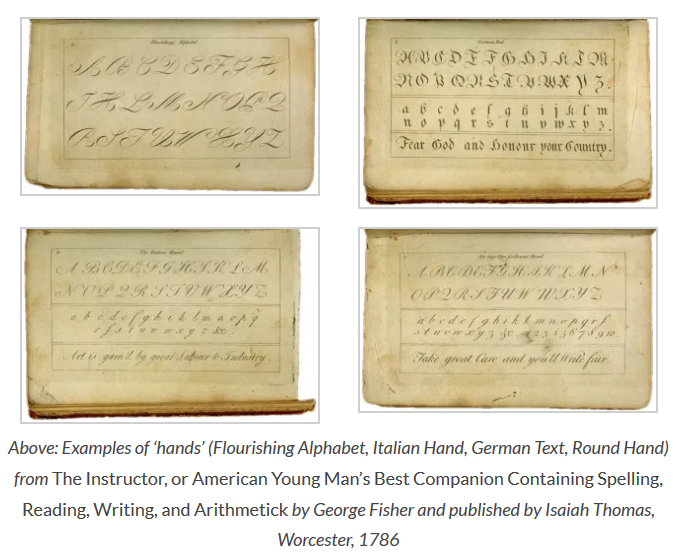
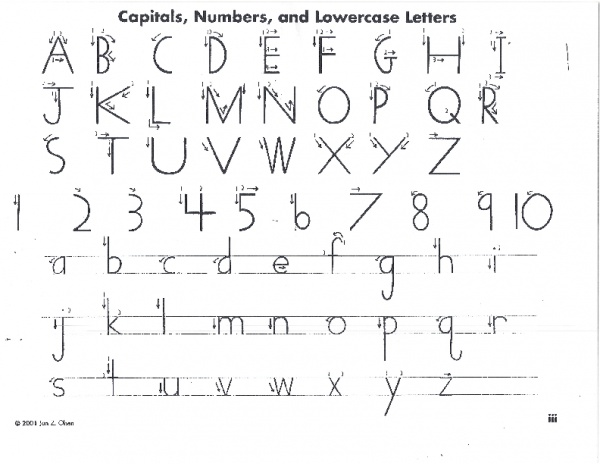
Below are two images. The one on the left is a collection of the four handwriting styles taught in 1786 to students ages 7 to 11 years old. All are more elaborate than cursive and would be considered the art of Calligraphy today. The image on the right is from lovetoteach.com and displays the manuscript style of handwriting, as is taught in schools across America today. Note that not only have we super simplified the letters and numbers of our alphabet, we have even created simplified plans for how they are formed. Students today must follow the 1, 2, 3s while creating their A, B, Cs. Any added serif-like flourish might be greatly discouraged. (13)
Arithmetic:
2017 State of North Dakota Math Education Standards, Grade 1 (3):
-Use strategies to add and subtract within 20, fluently add and subtract within 10
-Counting to 120, understanding base ten sequence
-Read and write numerals up to 120
-Read and write time via clock at hour and half-hour
-Order three objects by length,
-Identify dollar, quarter, dime, nickel and pennies. Count to 100 with dimes and pennies.
-Know shapes, be able to identify a shape separated into 2 equal parts known as “shares”
1837 Ray’s New Arithmetic, Grade 1 (10):
-Add and subtract up to 20s [fluently]
-Counting by ones, twos and threes, [no upper limit]
-Read and write numerals and number names up to 100
-Experienced using calendars, clocks, rulers, and multiple standard measuring systems
and devices found in American and England
-Use American and English money. Make change with pennies, nickels and dimes
-Know shapes
-Fractions 1/2, 1/3 and 1/4
(Currently most public schools teach fractions in 5th grade.)
2017 State of North Dakota Math Education Standards, Grade 2:
-Add and subtract fluently within 20
-Count by 5s, 10s, and 100s, Count within 1000
-Read and write figures and number names up to 1000
-Understand need for a standard system of measuring length, measure length in inches and centimeters
-Read and interpret bar graphs
-Arrange numbers in a rectangular array
1837 Ray’s New Arithmetic, Grade 2:
-Can solve all addition and subtraction
-Multiplication, solving problems within 100, times tables memorized for 5s and 10s
-Division, solving problems within 100, times tables memorized for 5s and 10s
-Fluent in use of American and English money up to $100
-Measure objects for length and weight using American and English standardized systems, including Troy weight, Avoirdupois weight and Apothecary weight
American students during the 1700s and 1800s were know to finish their school work and then read the Bible or sing hymns after completing their daily work. These things were not required but done for enjoyment. Most American adults also read Greek and Latin. “It was not unusual for a blacksmith to carry a Greek New Testament under his cap for reading during his lunch break.” (10) I could go on, but I think you get the point. “The Three R’s”, reading, ‘riting and ‘rithmetic are very different today.
So, we are here… and that’s important. We can’t move ahead onto a better path if we don’t know where we are. It’s kind of like a colorful, backlit, mall map… or perhaps it’s kind of like rock bottom. (Sadly, I don’t think we are yet at rock bottom.) Currently, we are here. Not only do we teach exponentially less than previous generations, we also don’t expect our students to even learn these few rudimentary things. That’s another hefty *share* of the problem.
We don’t expect our students to learn it all. We give them tests, but we don’t necessarily expect them to pass those tests. In the state of North Dakota, at least in 2014, 4th grade standardized tests were completed throughout the year. For 3 months the focus of all 4th graders is what will be on the health and science test. Then the test is given. History and language follow in similar blocks of time. This is nothing other than, “teaching the test” because we don’t trust that our students have successfully acquired the necessary knowledge. Thus, we take a whole year, filling up their temporary memory stores to all but guarantee that students are passing the tests. The tests that are tied to federal and state funding. Funding that our schools are supposedly using to teach our children.
The current Minnesota Department of Education Programming Guidance for Summer Schools, states, “for students enrolled for credit recovery purposes, decision makers must approach the creation of new assessment and grading systems with an equity mindset.” (4) Equity in education is the concern for equal outcomes. This does not however, mean that all students who graduate high school will have acquired and demonstrated a core knowledge set. What it means, is simply that all students (who attend a minimum of classes) will graduate. The state of Minnesota is effusively happy that the class of 2019 graduated an unprecedented (for the state of MN) 83.7% of enrolled students. (5) Given that funding for public schools is increasingly tied to graduation rates, it’s no surprise then that the state recommends grading equity. Nor should it be a surprise that grading systems all across America are moving toward the ECTS, European Credit Transfer and Accumulation System. ECTS is a lackluster student’s dream, a sliding-scale, bell curve. Sure, students in Minnesota are graduating, but teachers are calling a 39.5% a D-, thus a passing grade. Graduation rates are rising, but math proficiency rates have dropped 5 percentage points from 2016’s graduating class to 2019’s graduating class. (6) Anyone see anything wrong here?
Please note it’s not just Minnesota or North Dakota. Nationally, we rank 32 out of 79 nations for literacy and math proficiency. Just search “America math reading proficiency” in any web browser. In a state by state comparison, Minnesota is actually far above average. Now, maybe that’s because they are passing kids even when they have clearly failing test scores, but the idea that similar events are not occurring all across the nation? Unlikely. Even though both state and federal government funding is at least partially based on graduation rates, and thus grades, 18 state of Washington school districts aren’t even keeping accurate enough records to track graduation rates, let alone, actual grades. (7) So we really don’t know what the grades and graduation rates are in Washington. How many other states have the same or similar problem? We don’t know. It’s not likely to come up on the first page of a Google search.
All across the internet however, educational pundits are heralding the rising tide of grades. Educationnext.com shows a handy little spreadsheet of how grade averages used to be C’s and B’s but now, suddenly the grades are A’s.(8) See? Kids are getting A’s! There is no concern that schools have adopted ECTS style grading systems. Brookings.edu states that graduation rates have increased due to No Child Left Behind and similar legislation, and that these rates are not simply made up but actually accurately represent a new wave of more knowledgeable high school graduates. (9) Their reasoning? There’s no connection between schools that require a graduation exam (most don’t) and the graduation rates. This assumes that a graduation exam is the correct and best assessment of a student’s knowledge base. It further assumes that a graduation exam is graded on the basis of equality, not equity, and that the grading system does not include little details like calling a 39.5% grade “passing.” Yet, state officials and parents alike are busily patting themselves on the back. Very few are comparing current educational standards (which are exhaustively enumerated in legalese and educational rubric-speak) to the standards of the past. Meanwhile, college professors are teaching adults how to read, write and spell. Kindly bank tellers are teaching adults how to add and subtract, or simply doing it for them. Credit card companies are teaching adults the perils of not knowing how to multiply.
Where do we go from here? Well, I hate to agree with any sentiment from a Marxist, but the system is so bad that we might begin to consider dismantling it and starting over. It’s not just elementary school, it’s all of K-12. It’s not just K-12, it’s college too. It’s not just the teachers, it’s the teachers of the teachers. It’s not just the parents lack of knowledge and involvement, it’s the legislature that has made education regulation so complex as to need a lawyer and their team of legal assistants to unravel it’s Gordian knot. Similar to a system of leaky pipes, some of our students are getting through and may be said to be successful. But, the leaks are multiplying and our nation is filling up with a poorly educated and over looked population.
The best step in my opinion, is (no surprise here) home school your kids. If you can’t do that, over see each and every possible moment of your child’s education. Don’t accept anything less than excellence. When school work is over, learn something new together. And no, I don’t mean video games or what happened on the last episode of ______. Do you want your kids to understand their future credit card contract? Learn Latin, or at the very least, get out an actual weighty dictionary and crack that baby open. Never stop learning, communicating or setting goals to achieve together.
Still, we need to do more. Get involved in your child’s school in every way possible and start regularly communicating with your government representatives and demand real change. By real change, I mean going through every single educational rubric, understanding it and fixing it. Every time someone says, “Well 1st graders can’t learn [insert an advanced topic in reading, writing and arithmetic here]”, ask them why. Is it because they don’t want to teach it, or because your child could never ever learn it? For every time you are told that your child cannot learn, respectfully get a different teacher.
We need to “update” our educational standards, by consulting the past. We need to chose to spend less time teaching fringe, fun and feel-good topics and more time teaching what matters. What matters? The foundation. The age old adage applies well here. We cannot build our children’s knowledge base on one million small bits of one million scattered topics like sand and expect them to succeed. We must return to building our education on solid bedrock. We ought to expect no less than that all students easily and early demonstrate a fluent understanding of those famous 3R’s.
We are here and we are all in this together. So let’s stop sliding towards rock bottom. Please.
(1) https://infogalactic.com/info/American_Spelling_Book
(2) https://www.bartleby.com/293/75.html
(3) https://www.nd.gov/dpi/districtsschools/k-12-education-content-standards
(4) Summer Programming Guidance.pdf downloaded from https://education.mn.gov on 7/22/2020
(8) https://www.educationnext.org/states-raise-proficiency-standards-math-reading/
(10) Ray, Joseph, Ray’s New Primary Arithmetic, Mott Media, Milford MI, 1985, Print
(11) http://www.thephonicspage.org/On%20Reading/dyslexia.html
(13) https://www.snopes.com/fact-check/alyssa-cursive-writing/
 JUSTAMOM